|
The second case is illustrated in figure 1
Figure 1:
Length of summit curve (L<S)
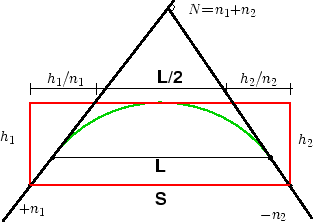 |
From the basic geometry, one can write
 |
(1) |
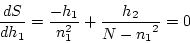
Therefore for a given  , ,  and and  to get minimum to get minimum  , differentiate
the above equation with respect to and equate it to zero.
Therefore, , differentiate
the above equation with respect to and equate it to zero.
Therefore,
 |
(2) |
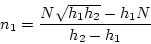
Solving for  , ,
 |
(3) |
Now we can substitute  back to get the value of minimum value of for a
given , back to get the value of minimum value of for a
given ,  , and .
Therefore, , and .
Therefore,
 |
(4) |
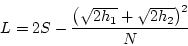
Solving for ,
 |
(5) |
When stopping sight distance is considered the height of driver's eye above the
road surface () is taken as 1.2 metres, and height of object above the
pavement surface () is taken as 0.15 metres.
If overtaking sight distance is considered, then the value of driver's eye
height () and the height of the obstruction () are taken equal as 1.2
metres.
|
|

